

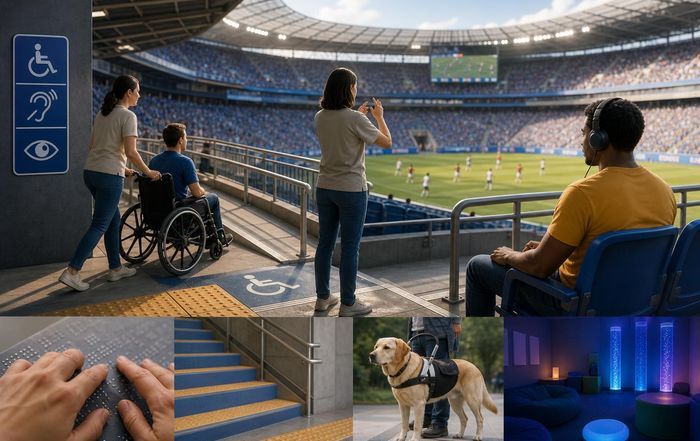
Accessibility Features Every Sports Event Should Consider
Designing a sports event that everyone can enjoy is no longer a nice-to-have; in many countries it is a legal requirement and, increasingly, a reputational necessity. From local road races to global tournaments, organisers are being judged not just on the spectacle on the field, but on how well they welcome disabled fans, athletes, staff, and media. Accessibility is also broader than disability: it touches language, culture, transport, safety, and digital access. For fitness and sports communities that pride themselves on inclusion, this is a critical test of values.
This new writeup looks at the practical accessibility features that should be considered for almost any sports event, whether it is a stadium match, a mass participation run, an outdoor fitness festival, or an e-sports competition. It draws on guidance from organisations such as the World Health Organization and the International Paralympic Committee, alongside lessons learned from recent major events, to identify what "good" looks like and where many events still fall short.
Why accessibility in sport matters - and what it really means
Accessibility in sports is often misunderstood as simply providing wheelchair ramps. In practice, it means ensuring that people with a wide range of impairments-mobility, visual, hearing, cognitive, mental health, and chronic health conditions-can safely and meaningfully participate as spectators, athletes, volunteers, or staff. According to the World Health Organization, more than a billion people worldwide live with some form of disability, and that number is rising with ageing populations and chronic disease. When events ignore accessibility, they are excluding a vast audience, along with their families and friends, from the health, social, and economic benefits of sport. At the same time, accessible design often improves comfort and safety for everyone, from parents with strollers to older adults and injured athletes.
Legally, many countries now require reasonable accommodations under frameworks such as the Americans with Disabilities Act in the United States, the Equality Act in the United Kingdom, and similar anti-discrimination laws in Europe, Asia, and beyond. These laws typically cover physical venues, digital platforms, employment practices, and communications. But regulation is only a baseline. Leading organisations such as UNESCO, the International Paralympic Committee, and national disability sports bodies advocate going further, embedding universal design from the earliest planning stages rather than retrofitting fixes later. For event organisers focused on health, fitness, and community, this approach aligns naturally with broader wellness and inclusion goals covered in areas like health and wellness.
Getting there: transport, arrival, and first impressions
Accessibility begins long before a fan reaches their seat or an athlete steps into the warm-up area. For many disabled people, the biggest barrier is simply getting to and from the venue. Event websites and ticketing platforms should provide clear, prominent information about accessible public transport routes, step-free stations, shuttle services, and drop-off points. In cities where public transport is limited, partnering with local authorities, taxi cooperatives, or ride-share companies to ensure accessible vehicles are available can make a significant difference. Guidance from organisations like Transport for London and the U.S. Department of Transportation highlights that real-time information about lifts, ramps, and service disruptions is particularly important for disabled travellers.
Once on site, the journey from arrival to entry needs to be smooth and predictable. That means step-free routes from parking or transit stops, firm and even surfaces, and clearly signed accessible entrances that are actually open and staffed. Temporary events often rely on grass or uneven ground; in these cases, organisers can use matting or modular pathways to create stable routes for wheelchair users, people with walkers, and those with balance issues. Parking policies should reserve accessible bays close to entrances, with enough space for side and rear vehicle lifts. Staff at entry points must be trained to recognise disability passes, service animals, and mobility devices without unnecessary questioning or delays. For many fans, that first interaction sets the tone: a seamless, respectful arrival can be as important to the overall experience as anything that happens during the competition.
Accessible venue design: seating, circulation, and sightlines
Inside the venue, seating and circulation are where accessibility is most visible-and where errors are most obvious. Accessible seating should be distributed throughout the venue, not confined to a single corner. Fans with disabilities should have the same choice of price range, viewing angle, and proximity to the action as other spectators. Guidelines from bodies such as the International Paralympic Committee and national building standards emphasise that wheelchair spaces must include companion seats, flexible options for larger mobility devices, and clear sightlines even when other spectators stand up. Too often, accessible seats are placed behind railings or in areas where flags and banners block the view, undermining the whole point of the accommodation.
Circulation routes need similar attention. This includes step-free access via ramps or lifts to all key areas: seating blocks, concessions, toilets, first-aid rooms, hospitality zones, and fan engagement spaces. Ramps must meet appropriate gradient standards, have handrails, and be free of obstacles; lifts should be clearly signed, large enough for power chairs, and not used for storage. Wayfinding is critical: large, high-contrast signs, consistent pictograms, and logical numbering systems can help people with visual or cognitive impairments navigate independently. For major events, some venues now provide tactile floor indicators and raised-relief maps, which can be particularly useful for blind or low-vision visitors. These physical design choices align with broader expectations around safe and inclusive sports environments.
Toilets, changing spaces, and personal care
Accessible toilets and changing facilities are among the most frequently cited concerns for disabled spectators and athletes, yet they often receive less attention than seating or entrances. At a minimum, events should provide accessible toilet cubicles that meet national standards for door width, turning space, grab rails, and sink height. However, many adults and children require more than a standard accessible toilet. The Changing Places movement, which began in the UK and has influenced policy in several countries, advocates for larger accessible changing rooms equipped with adult-sized changing benches and hoists. For multi-hour events or tournaments, a small number of such facilities can be transformative for families who would otherwise have to leave early or skip the event entirely.
Location and maintenance matter as much as design. Accessible toilets should be distributed across the venue, clearly signed, and not used as storage for cleaning equipment or event supplies. Queues can be a challenge; some events introduce priority access systems or designate volunteers to manage lines respectfully. For athletes, especially at endurance or multi-sport events, accessible showers and changing rooms are critical. These spaces should be planned in consultation with disabled athletes and organisations, ensuring that privacy, dignity, and cultural expectations are respected. This attention to personal care facilities is part of a broader trend towards holistic athlete welfare, overlapping with themes in fitness and nutrition coverage.
Inclusive information: signage, announcements, and wayfinding
Information is only useful if people can perceive and understand it. That principle, central to digital accessibility standards such as the Web Content Accessibility Guidelines promoted by the World Wide Web Consortium, applies equally to physical environments. Event signage should use clear, simple language, high-contrast colours, and readable fonts at appropriate sizes. Pictograms, arrows, and universally recognised symbols often communicate more effectively than text alone, especially for international audiences or people with cognitive impairments. Consistency across the venue helps visitors build a mental map, reducing anxiety and reliance on staff.
Audio announcements-about safety, schedule changes, or transport-should be paired with visual displays, such as scoreboards, LED ribbons, or mobile app notifications, to ensure that deaf and hard-of-hearing spectators receive the same information. Conversely, visual information should be backed up with audio cues for blind and low-vision visitors, whether through public address systems or optional audio description devices. Some major events now provide tactile maps and QR codes that link to accessible digital guides, allowing users to explore information in their preferred format. For large, complex venues, this multi-channel approach to wayfinding can be as important as physical ramps or lifts in making the event genuinely navigable.
Communication access: hearing, vision, and language support
Effective communication support is one of the most powerful ways to make sports events inclusive. For deaf and hard-of-hearing spectators, this often means a combination of sign language interpretation, captioning, and assistive listening systems. In countries where a national sign language is recognised, it is increasingly common to see interpreters on stage during opening ceremonies or on big screens during key moments. However, routine announcements, emergency messages, and fan engagement activities also need to be accessible. Real-time captioning on scoreboards or mobile apps, using trained stenographers or speech-to-text technology, is becoming more feasible and is recommended by organisations such as the National Association of the Deaf in the United States.
For blind and low-vision audiences, audio description of the on-field action can make the difference between a frustrating experience and full immersion. Some football and cricket stadiums now offer dedicated commentary channels that describe visual details-player movements, facial expressions, crowd reactions-rather than standard broadcast commentary. Devices can be loaned at information points, or streams can be accessed through personal smartphones. Language is another dimension of accessibility. International events should consider multilingual signage and basic interpretation services, while community events may need to address literacy barriers. Clear, jargon-free language benefits everyone, including people with learning disabilities or cognitive impairments. These communication features complement wider efforts in world and culture coverage to make global sport more inclusive and understandable.
Digital accessibility: websites, apps, and ticketing
For many fans and athletes, the first point of contact with an event is digital: a website, ticketing portal, or mobile app. If that experience is inaccessible, people may never make it to the venue. International standards such as the Web Content Accessibility Guidelines, referenced by governments and regulators from the European Commission to the U.S. Department of Justice, provide a robust framework. Event websites should support screen readers, keyboard navigation, and text resizing; offer sufficient colour contrast; and avoid flashing content that could trigger seizures. Images, including seating maps and venue diagrams, should have descriptive alternative text. Forms for registration, volunteering, or accreditation must be usable without a mouse and should provide clear error messages.
Ticketing is a persistent pain point. Many platforms make it difficult or impossible to select accessible seating, to book companion tickets, or to communicate specific access needs. Best practice is to allow disabled customers to choose accessible seats directly online, with transparent pricing and the same promotional access as other fans. Contact details for dedicated accessibility support should be easy to find, with multiple channels (email, phone, and sometimes live chat) and reasonable response times. Mobile apps, increasingly used for digital tickets, in-stadium navigation, and food ordering, must be tested with assistive technologies across major operating systems. As sports events lean more heavily on technology, aligning with broader technology and innovation trends, digital accessibility is becoming as central as physical design.
Supporting athletes with disabilities: competition, training, and safety
Accessibility is not only about spectators. Many sports events include disabled athletes, whether in dedicated para-sport competitions, integrated events, or community races with adaptive categories. International frameworks from the International Paralympic Committee and national paralympic committees provide detailed classification and competition rules, but event organisers still need to address practical elements. This includes accessible registration processes, clear information on classification and equipment rules, and consultation with disability sports organisations during planning. Training facilities and warm-up areas should mirror the accessibility of competition venues, with step-free access, accessible toilets and changing rooms, and safe storage for mobility or assistive devices.
Safety and medical support require specific planning. Medical teams should be briefed on common impairments and assistive technologies, and protocols should be established so that devices such as wheelchairs or prosthetics are not removed without consent unless absolutely necessary. Evacuation plans must account for athletes and staff who cannot use stairs, as well as for service animals. Heat, cold, and altitude can affect some disabilities differently, which has implications for hydration, rest areas, and monitoring during endurance events. Integrating disabled athletes fully into the event-rather than treating them as an add-on-sends a powerful message about inclusion and aligns with broader health and environment considerations around safe competition conditions.
Training staff and volunteers: culture is as important as infrastructure
Even the best-designed venue can feel unwelcoming if staff and volunteers are unsure how to interact with disabled people respectfully. Disability awareness training is therefore a core accessibility feature, not an optional extra. This training should cover basic etiquette-such as speaking directly to the person rather than their companion, asking before offering assistance, and understanding that not all disabilities are visible-as well as practical procedures around ticketing, seating, and emergency response. Organisations such as Scope in the UK and the National Disability Authority in Ireland emphasise that training should be scenario-based, giving staff the chance to practice responses to common situations.
Volunteers, who are central to many community and major events, also need clear guidance. This includes knowing where accessible facilities are located, how to operate assistive technologies like portable ramps or listening devices, and how to respond if a disabled spectator reports a problem. A culture of openness-where staff feel comfortable asking questions and disabled spectators feel able to give feedback-helps identify issues early. Some events now create dedicated accessibility teams or appoint access stewards who can be contacted directly by radio or via an information desk. This people-focused approach complements physical design and digital tools, recognising that inclusion is ultimately about human interaction as much as infrastructure.
Health, safety, and emergency planning with accessibility in mind
Emergency planning is often where accessibility gaps become most dangerous. Evacuation routes that rely on stairs, inaccessible refuge points, or unclear communication can put disabled spectators and athletes at disproportionate risk. Guidance from national fire safety agencies and disability advocacy groups stresses that personal emergency evacuation plans (PEEPs) should be available where practical, particularly for staff, volunteers, and athletes with mobility or sensory impairments. Venues need clearly marked refuge areas, evacuation chairs where appropriate, and staff trained in their use. Emergency announcements must be delivered in multiple formats-audio, visual, and sometimes tactile or vibratory alerts-to reach as many people as possible.
Health and wellness considerations extend beyond acute emergencies. Extreme heat, cold, or poor air quality can affect people with respiratory conditions, cardiovascular disease, or certain medications differently. Organisers should monitor environmental conditions, provide shaded or climate-controlled rest areas, and make drinking water easily available. First-aid teams should be briefed on how some impairments may affect pain expression or communication, and how to work with interpreters or support persons if needed. In mass participation events such as marathons or charity runs, start waves, cut-off times, and course design should allow for a range of paces and assistive devices, while maintaining safety for all participants. These considerations align with a broader public health perspective seen in resources from organisations like the Centers for Disease Control and Prevention and the World Health Organization.
Affordability, ticket policies, and fair access
Accessibility is not only physical or digital; it is also economic. Disabled people are more likely to experience poverty or unstable employment in many countries, according to data from bodies such as the OECD and the World Bank. High ticket prices, inflexible booking policies, and additional costs for companions can therefore be significant barriers. Fair access policies might include discounted tickets for disabled spectators, free or reduced-price companion tickets, and flexible refund or transfer options when health conditions change unexpectedly. These policies should be transparent and easy to find, rather than buried in small print or available only by special request.
Demand management is another challenge. Accessible seating areas are often limited, and some events have struggled with reselling or misallocation of those tickets. Clear eligibility criteria, respectful verification processes, and systems to prevent abuse without deterring genuine users are all part of responsible ticketing. Some venues now maintain waiting lists for accessible seats and offer priority booking for disabled fans who attend regularly. In community and grassroots events, entry fees should be reviewed with disabled participants in mind, especially when they need to pay for specialised transport or support workers. These financial considerations intersect with wider business and jobs discussions about the sports industry's responsibility to reduce inequality.
Involving disabled people in planning and evaluation
Perhaps the most important accessibility feature is not a ramp, a captioning screen, or an app-it is the systematic involvement of disabled people in planning, delivery, and evaluation. The disability rights movement's principle of "Nothing about us without us," promoted by organisations such as the International Disability Alliance, applies strongly to sports events. Advisory panels, co-design workshops, and formal partnerships with disability organisations can provide practical insights that designers and planners might otherwise miss. This might include feedback on seating layouts, signage wording, sensory environments, or the accessibility of volunteer recruitment processes.
Evaluation should continue after the event. Collecting feedback from disabled spectators, athletes, staff, and volunteers-through surveys, focus groups, or informal conversations-helps identify what worked and what needs improvement. Publicly sharing at least some of these findings, and outlining concrete steps for future events, builds trust and accountability. Over time, this iterative approach can turn accessibility from a compliance obligation into a core strength and differentiator. For sports and fitness communities aiming to model inclusive, health-promoting environments, this long-term commitment is crucial.
Moving from minimum standards to meaningful inclusion
When accessibility is treated as a checklist of ramps, toilets, and reserved seats, sports events may technically comply with regulations but still feel exclusionary. Moving towards meaningful inclusion requires a broader mindset: one that sees disabled people as athletes, fans, workers, and leaders with diverse needs and aspirations. It involves integrating accessibility into every stage of event planning-from site selection and budgeting to marketing, volunteer training, and legacy planning-rather than bolting it on at the end.
For organisers, this shift can seem daunting, especially for smaller events with limited resources. Yet many improvements are low-cost or cost-neutral: clearer signage, better staff training, transparent ticket policies, and more accessible digital information. Others, such as upgrading toilets or installing lifts, require investment but deliver long-term benefits for all users. As major international bodies from the International Olympic Committee to national sports ministries place growing emphasis on inclusion, expectations will continue to rise. Events that embrace accessibility now are not only doing the right thing ethically; they are also positioning themselves to reach wider audiences, attract more diverse talent, and contribute to a sports culture that genuinely reflects the communities it serves.