

Can Motion Capture Really Improve Your Home Exercise Form?
Home workouts have never been more popular, but training without a coach in the room comes with a familiar problem: how do you know if your form is actually safe and effective? From smartphone apps that track your squats to smart mirrors that "see" your push-ups, motion capture is moving out of elite sports labs and into living rooms. The question is whether these tools genuinely help people move better, or simply add another layer of tech to an already crowded fitness landscape.
This home fitness article looks at how motion capture works, what the evidence says about its impact on exercise technique, where it fits into a broader training plan, and what to consider if you are thinking about using it at home.
What "Motion Capture" Means in a Home Workout
In sports science, motion capture traditionally refers to multi-camera systems that track reflective markers on the body, generating extremely precise 3D models of movement. These setups, used in research labs and by elite teams, can cost tens or hundreds of thousands of dollars and require expert operators. Home users are not buying that technology, but several related approaches now fall under the same umbrella in consumer fitness.
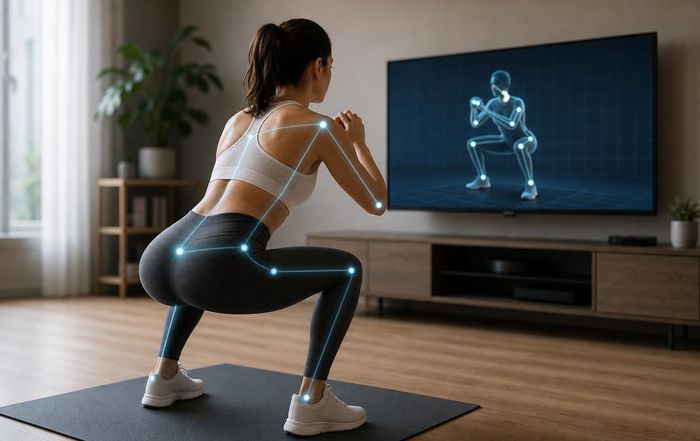
Most home motion capture falls into three broad categories. The first is camera-based systems, which use computer vision to estimate joint positions from regular video. Many smartphone apps and connected fitness platforms rely on a single front-facing camera, sometimes combined with depth sensors. Products in the "smart mirror" category use integrated cameras to track you during guided workouts. The second category is wearable sensors, such as inertial measurement units (IMUs) found in some smart clothing, belts, or bands. These track acceleration and rotation to infer joint angles and movement patterns, often sending data to a phone or tablet. A third, more niche category involves gaming and mixed reality platforms, where devices like VR headsets and motion controllers approximate body position well enough for basic exercise feedback.
All of these systems share a similar promise: by reconstructing how your joints move in space, they can compare your pattern to a target model, flag deviations, and deliver real-time cues. That might mean a prompt to "sit back more" in a squat, a warning that your knees are collapsing inward, or a suggestion to slow down and control the eccentric phase of a lift. For people training alone at home, this creates something closer to the experience of being watched by a coach, even if the "coach" is an algorithm running on a phone.
What the Research Says About Motion Capture and Movement Quality
The scientific literature on motion capture in home fitness is still developing, but several strands of research are relevant. Clinical and sports biomechanics labs have long used marker-based motion capture to analyze injury mechanisms and refine technique. Organizations such as the American College of Sports Medicine (ACSM) and National Strength and Conditioning Association (NSCA) draw on this type of research to shape technique guidelines for squats, deadlifts, running mechanics, and plyometric drills. The same biomechanical principles underpin the algorithms that power consumer motion-tracking tools.
More recently, studies have examined whether simpler, markerless systems can reliably estimate joint angles and identify common technique faults. Research comparing markerless camera systems with gold-standard lab setups generally shows acceptable accuracy for large, gross movements like squats, lunges, and basic upper-body exercises, especially in the sagittal plane (side view). Accuracy tends to drop for more complex or rotational movements and in environments with poor lighting or cluttered backgrounds. Academic groups at institutions like Stanford University and MIT (stanford.edu, mit.edu) have published work showing that modern computer vision models can track human pose robustly from a single camera, but still fall short of high-end lab systems.
When it comes to outcomes that matter to home exercisers-better form, less pain, more progress-the evidence is encouraging but not yet definitive. Small trials have found that real-time visual or auditory feedback based on motion tracking can improve joint alignment and reduce known risk factors, such as excessive knee valgus during jump landings or squats. These findings are consistent with broader motor learning research, where augmented feedback (external cues beyond your own sensations) is known to accelerate skill acquisition. Organizations like the World Health Organization (WHO) and U.S. Centers for Disease Control and Prevention (CDC) emphasize the importance of safe, regular strength and balance training, and motion capture-based feedback appears to be one promising way to support that at scale.
However, many studies are short-term, involve small groups, or use lab-grade equipment rather than commercial devices. There is still limited long-term data on whether home motion capture reduces injury rates, improves adherence, or leads to better strength and performance outcomes in the general population. For now, the weight of evidence suggests that motion capture can meaningfully improve awareness of technique and correct obvious errors, particularly for beginners, but it is not a magic shield against injury or a replacement for individualized coaching when complex problems arise.
How Motion Capture Actually Improves Form in Practice
For motion capture to improve exercise form, it must do more than simply measure movement; it needs to provide feedback that is understandable, timely, and actionable. In practice, home systems use a few key strategies to influence how people move.
One of the most powerful tools is real-time cueing. When a camera or sensor detects that your back is rounding in a deadlift, or that your shoulders are shrugging during a press, the app may deliver a spoken cue, a sound, or a visual overlay showing the correct position. This kind of immediate external feedback helps the nervous system link a particular body sensation to a clear corrective action. Over repeated repetitions, many users learn to internalize those cues and self-correct even without the device, which is the ultimate goal. This process aligns with well-established motor learning principles used by coaches and physical therapists.
Another mechanism is post-session analysis. Some platforms provide summary reports highlighting which exercises showed the most deviation from target form, how your range of motion changed over time, or whether asymmetries between left and right limbs have narrowed or widened. For motivated home athletes, this data can guide exercise selection, warm-up focus, or decisions about when to progress load. It can also be shared with a remote coach or clinician, forming the basis for hybrid models of care and training that combine technology with human expertise. This fits neatly with the rise of telehealth and remote coaching services, which are increasingly recognized by health systems and insurers in countries such as the United States and parts of Europe.
A third, subtler benefit is attention and engagement. Knowing that your movement is being analyzed tends to make people pay closer attention to their form. That heightened awareness can lead to more deliberate, controlled repetitions and fewer distractions during a workout. For some, the gamification features built into motion capture platforms-scores for "technique quality," badges for consistent form, or leaderboards-add another layer of motivation. While gamification is no substitute for intrinsic motivation, it can help some users stick with a program long enough to build lasting habits, especially when combined with structured training plans and educational content that explain why certain positions are safer or more efficient.
Limits, Risks, and Blind Spots of At-Home Motion Capture
Despite its promise, consumer-grade motion capture has clear limitations that matter for anyone relying on it to guide their training. Accuracy is a primary concern. Single-camera systems can struggle with occlusion (when one body part blocks another), unusual body proportions, loose clothing, or non-standard exercise variations. Depth sensors and multiple cameras can improve tracking but introduce cost, complexity, and setup challenges. Wearable sensors avoid some of these issues but may shift during movement, and they only track the joints where sensors are placed, potentially missing compensations elsewhere.
Another challenge is context. Motion capture can detect that your knee moves inward during a lunge, but it cannot automatically determine why. The cause might be hip weakness, ankle mobility restrictions, fatigue, or even a long-standing anatomical variation that is not inherently dangerous for you. Overzealous correction of every deviation from a generic "ideal" model could, in some cases, create new problems or encourage rigid, unnatural movement patterns. Sports medicine bodies such as the American Physical Therapy Association (APTA) emphasize that pain history, previous injuries, and individual anatomy all influence what "good form" looks like for a specific person-factors that current home systems only approximate at best.
There is also a risk of over-reliance on numbers and scores. When apps assign a technique score or flag "errors" in red, users may chase perfect metrics rather than listening to their bodies. Some discomfort is normal when learning new skills or training hard, but pain that is sharp, localized, or persistent is a different signal. Motion capture cannot feel your pain or fully interpret it. Relying on form scores while ignoring symptoms may delay necessary rest or medical assessment. Guidance from organizations like the National Health Service in the UK (NHS) and similar health agencies is clear: ongoing pain, swelling, or loss of function during exercise should be evaluated by a qualified professional.
Privacy and data security present further concerns. Motion capture often involves recording video or detailed movement data inside your home. Depending on the platform, this data may be stored on company servers, used to train machine learning models, or shared with third parties. Regulations such as the EU's General Data Protection Regulation (GDPR) have raised the bar for data privacy, but not all fitness startups operate with the same rigor. Before adopting any motion capture tool, users should review privacy policies, data retention practices, and options for deleting their data, especially if other household members, including children, may appear on camera.
Where Motion Capture Fits in a Broader Home Training Strategy
For home exercisers, motion capture is best viewed as one tool in a broader strategy rather than a standalone solution. It can be particularly useful during foundational phases, when someone is learning core movement patterns like squats, hinges, pushes, pulls, and carries. In this stage, feedback about joint alignment, tempo, and range of motion can prevent the early development of poor habits that are harder to change later. Combining motion capture with high-quality instructional content, whether from reputable fitness organizations, certified coaches, or evidence-based platforms, can accelerate this learning curve.
As training progresses, motion capture can support periodic technique audits. Even experienced lifters and endurance athletes benefit from occasional external feedback to catch drift in their form under heavier loads or higher fatigue. Integrating motion tracking into a weekly or monthly check-in can help identify when it might be time to adjust volume, address mobility or stability deficits, or consult a professional. This kind of self-monitoring aligns well with broader wellness goals and can be combined with tracking tools for sleep, nutrition, and stress, such as those covered in our wellness and nutrition sections.
Motion capture can also enhance remote coaching and rehabilitation. A growing number of physiotherapists and strength coaches now work with clients entirely online, using shared video, wearable data, and app-based platforms. When a client can send motion-captured summaries of their home exercises, practitioners gain a richer picture than simple self-reports. This is particularly relevant for return-to-sport protocols, balance and fall-prevention programs for older adults, or post-injury strength rebuilding. Readers interested in the intersection of technology and care delivery will find related coverage in our health and technology verticals.
Finally, motion capture can play a role in inclusive and adaptive fitness. For people with disabilities or chronic conditions, small changes in movement quality can have outsized effects on pain, fatigue, or functional independence. Thoughtfully designed motion-tracking systems, especially those co-developed with clinicians and users, may help tailor exercise prescriptions more precisely. That said, this is an area where collaboration with healthcare professionals is especially important, and generic consumer apps may not yet provide the nuance needed.
Practical Tips for Using Motion Capture Safely and Effectively at Home
For those considering motion capture as part of a home training setup, a few practical guidelines can maximize benefits while minimizing downsides. First, choose tools that prioritize education, not just scoring. Platforms that explain why a particular alignment matters, offer regressions or modifications, and provide context for their feedback are generally more helpful than those that simply assign a number or label movements as "good" or "bad." Look for content that aligns with principles from organizations such as ACSM, NSCA, or your national sports medicine body.
Second, pay attention to setup and environment. Camera-based systems work best with consistent lighting, clear contrast between you and the background, and enough space for full-body movement. Wearing reasonably fitted clothing that outlines your joints can improve tracking accuracy. For wearable sensors, ensure they are secured according to manufacturer instructions and periodically check that they have not shifted during the session. These small details can significantly affect how reliable the feedback is.
Third, integrate motion capture with subjective signals-how you feel during and after training. If feedback suggests that your form is "perfect" but you consistently experience sharp pain in a joint, treat the pain as the higher-priority signal and adjust your program, reduce load, or seek professional advice. Conversely, if the system flags minor deviations but you feel strong, stable, and pain-free, use the feedback as a cue for gradual refinement rather than an emergency to fix immediately. Over time, a balance between objective and subjective information tends to produce the most sustainable progress.
Fourth, consider data privacy and long-term use. Before committing to a subscription or hardware ecosystem, review how the company handles your data, whether you can export or delete it, and how locked-in you will be if you later decide to change platforms. Established consumer tech and health companies, as well as major wearables brands like Apple, Google, or Garmin (apple.com, google.com, garmin.com), often have more mature data governance frameworks than very new startups, though policies still vary widely.
Finally, remember that progressive overload, consistency, and recovery remain the pillars of any effective fitness program. Motion capture can help you apply load more safely by refining technique, but it does not replace thoughtful programming, adequate sleep, and appropriate nutrition. Our fitness and sports coverage regularly explores how these elements interact, especially for people balancing training with busy work and family lives.
So, Can Motion Capture Improve Home Exercise Form?
Taken together, the evidence and real-world experience suggest that motion capture can indeed improve home exercise form, especially for beginners and for relatively simple strength and conditioning movements. By offering real-time cues, post-session analysis, and a sense of being "seen" while training alone, it helps bridge part of the gap between unsupervised home workouts and in-person coaching. Markerless camera systems and wearables, powered by advances in computer vision and machine learning from leading research centers and tech companies, are now accurate enough in many scenarios to spot major technique issues and guide useful corrections.
At the same time, these tools are not infallible. They can misinterpret movements, lack context about your injury history or anatomy, and sometimes nudge users toward chasing scores rather than listening to their bodies. They work best when combined with sound training principles, attention to how you feel, and, when needed, input from qualified professionals. For complex pain, persistent problems, or high-performance goals, human expertise remains irreplaceable.
For readers building or refining a home training setup, motion capture is worth considering as a supportive layer-one that can make workouts more informed, engaging, and, in many cases, safer. Used thoughtfully and critically, it has the potential to turn your living room into a more effective training space, not by replacing good coaching and common sense, but by extending their reach. Those interested in how such technologies evolve, from elite sport to everyday wellness, can follow ongoing 100% original reporting in our innovation, business, and news pages as the field continues to develop.