
Bodyweight Training Progressions for Every Fitness Level
The New Era of Bodyweight Training
Bodyweight training has moved from being a minimalist alternative to gym-based exercise to becoming a central pillar of performance, health, and corporate wellness strategies across the globe. From remote workers in the United States to athletes in Germany and busy executives in Singapore, the ability to train effectively without heavy equipment has proven invaluable in a world that prizes flexibility, resilience, and sustainable performance. For the readers visiting us here, who consistently track key events in fitness, health, and sports, bodyweight training progressions represent a uniquely practical way to align personal wellbeing with demanding professional and cultural realities.
Bodyweight training is no longer associated merely with basic push-ups or sit-ups performed in school gyms; instead, it is now underpinned by a growing body of sports science, digital coaching technologies, and high-performance methodologies used by elite organizations such as NASA, which has long relied on bodyweight and minimal-equipment protocols to keep astronauts strong in microgravity. As leading institutions like Harvard Medical School and the Mayo Clinic continue to emphasize the benefits of strength and mobility for long-term health, the need for structured progressions that can support individuals at every level-from beginners returning to exercise to advanced athletes seeking new stimulus-has never been greater.
Why Progressions Matter More Than Motivation
Across North America, Europe, and Asia, many fitness initiatives still fail not because individuals lack motivation, but because they lack a clear, progressive structure that adapts as they get stronger, leaner, and more resilient. Without progressions, beginners often push too hard too soon, risking injury and burnout, while more experienced individuals stagnate with unchanging routines that no longer challenge their neuromuscular systems or support their performance goals. By contrast, a progression-based approach to bodyweight training provides a scalable framework that aligns with the principles of progressive overload, motor learning, and recovery, which are consistently highlighted in resources such as the American College of Sports Medicine and the National Strength and Conditioning Association.
For readers of FitPulseNews, who frequently navigate the intersection of business, innovation, and personal performance, understanding these progressions is particularly important. Executives in London, software engineers in Berlin, creatives in Sydney, and entrepreneurs in Toronto often operate in high-stress environments with limited time and variable access to training facilities. Structured progressions allow them to build strength, mobility, and cardiovascular capacity in a way that fits into unpredictable schedules and can be performed anywhere, from a small apartment in Tokyo to a hotel room in New York.
Foundations: Assessing Readiness and Setting Objectives
Before engaging in any structured progression, individuals must understand their baseline and goals. Leading health authorities such as the World Health Organization and the U.S. Centers for Disease Control and Prevention emphasize that adults should accumulate at least 150-300 minutes of moderate-intensity aerobic activity per week, along with muscle-strengthening activities on two or more days. However, these are population-level recommendations; effective progressions require more specific alignment with personal objectives such as fat loss, muscle gain, athletic performance, injury prevention, or longevity.
For the healthy and happy community online, whose important interests are wellness, nutrition, and culture, a comprehensive approach begins with clarifying whether the primary focus is improving functional strength for daily tasks, enhancing performance in sports like football, running, or tennis, supporting mental health and stress management, or building a physique that reflects personal and professional aspirations. Leading organizations such as Cleveland Clinic and Johns Hopkins Medicine provide accessible guidance on how physical activity interacts with cardiometabolic health and mental wellbeing, helping individuals understand why a structured plan is not just about aesthetics but also about long-term disease prevention and cognitive performance.
A foundational assessment might include the ability to perform controlled squats, push-ups (even if modified), hip hinges, and plank variations without pain, along with simple balance tests and a short walk or stair climb to gauge cardiovascular tolerance. Individuals with underlying conditions, recent injuries, or chronic pain are consistently advised by medical authorities to consult qualified healthcare professionals before embarking on more intensive progressions, reinforcing the importance of trust and safety in any training journey.
Beginner Progressions: Building Capacity and Confidence
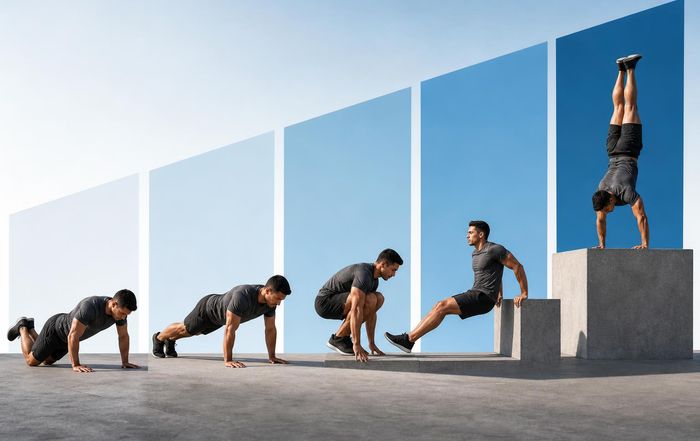
For beginners or those returning to training after a long break, the primary goals are movement quality, joint integrity, and consistency. In this phase, bodyweight training progressions emphasize simplified versions of fundamental movement patterns-squatting, hinging, pushing, pulling, and bracing-performed at a controlled pace with ample rest. Reputable educational platforms such as Examine.com and the National Institutes of Health highlight that even modest, consistent strength work can produce measurable improvements in insulin sensitivity, bone density, and muscular endurance.
In practical terms, this stage might involve wall push-ups progressing to incline push-ups on a sturdy surface, bodyweight squats with a controlled range of motion, hip bridges to strengthen the posterior chain, and static planks or dead bugs to develop core stability. For many readers across Canada, Australia, and France, this beginner phase can be integrated into short, daily sessions that complement walking or light cycling, allowing the body to adapt without excessive soreness or fatigue that could interfere with demanding work schedules. Those who track health and performance through wearables, a trend increasingly covered in technology and wellness media, can monitor heart rate responses and recovery quality to ensure that sessions remain within an appropriate intensity range.
Crucially, the psychological dimension of beginner progressions cannot be underestimated. Research summarized by institutions like Stanford University underscores how early wins and a sense of mastery increase adherence and long-term habit formation. When individuals see that they can move from a wall push-up to an incline push-up, or from a 15-second plank to a 30-second plank, they begin to build not only muscular strength but also self-efficacy, which is a core component of sustainable behavior change in both fitness and business environments.
Intermediate Progressions: From General Fitness to Performance
Once foundational movements are stable and pain-free, and a base of cardiovascular fitness is established, individuals can progress to more demanding variations that increase mechanical tension, range of motion, and neuromuscular coordination. In this intermediate phase, bodyweight training becomes a powerful tool for reshaping body composition, supporting sports performance, and enhancing metabolic health, aligning with the growing interest among FitPulseNews readers in performance-oriented sports and brands that cater to active lifestyles.
At this level, standard push-ups, deep squats, Bulgarian split squats using a chair or bench, inverted rows under a sturdy table or bar, and dynamic core exercises such as mountain climbers and hollow body holds begin to feature more prominently. Reputable sources like the British Journal of Sports Medicine and the European Society of Cardiology continue to publish research demonstrating that higher-intensity muscular work can significantly improve cardiovascular markers, even in the absence of traditional endurance training, which is particularly relevant for time-constrained professionals in London, Zurich, or Hong Kong.
For intermediate trainees, progression is not only about harder exercises but also about manipulating volume, tempo, and work-to-rest ratios. Slower eccentrics, partial pauses, and controlled isometrics can dramatically increase the challenge of familiar movements without adding external load, while circuit structures or interval formats introduce a cardiovascular component that mirrors the demands of many sports and high-pressure professions. In parallel, attention to recovery, sleep hygiene, and nutrition becomes more critical, with organizations like The American Heart Association and The Nutrition Source at Harvard T.H. Chan School of Public Health offering evidence-based guidance on how protein intake, micronutrients, and sleep duration interact with training stimulus to drive adaptation.
Advanced Progressions: Skill, Power, and High Performance
For advanced trainees, including athletes, military personnel, and high-performing professionals who have trained consistently for several years, bodyweight progressions become an avenue for skill development, power production, and joint-friendly loading that can complement or even partially replace heavy external resistance. In 2026, advanced bodyweight training is heavily influenced by disciplines such as gymnastics, calisthenics, and parkour, which have gained traction across South Korea, Brazil, Spain, and the Netherlands, as social media and digital platforms showcase complex skills executed with remarkable control and strength.
At this stage, progressions may include one-arm push-ups, pistol squats, advanced pulling variations such as archer or typewriter pull-ups (where equipment like a bar is available), and core-intensive skills such as hanging leg raises, front lever progressions, and planche work. Reputable training institutions and high-performance centers, including the Australian Institute of Sport and UK Sport, have increasingly highlighted the role of bodyweight skills in developing joint integrity, proprioception, and power-to-weight ratio, all of which are critical for sports ranging from climbing and martial arts to football and basketball.
Advanced progressions demand meticulous attention to periodization, deloading, and mobility work, as the mechanical stress on tendons and connective tissues can be significant. Resources from the International Olympic Committee and the International Association of Athletics Federations emphasize that elite performance is built on a foundation of structured recovery, load management, and injury-prevention protocols, which can be adapted by non-elite trainees who aspire to train with similar discipline and foresight. For people operating in high-stakes world and news environments, the discipline required for these advanced progressions often parallels the strategic planning and risk management needed in their professional lives.
Integrating Mobility, Stability, and Injury Prevention
Across all levels, from beginner to advanced, effective bodyweight progressions are inseparable from mobility and stability work. Organizations such as Physiopedia and the Chartered Society of Physiotherapy consistently stress that strength training without adequate joint preparation and soft-tissue care can lead to overuse injuries, particularly in the shoulders, knees, and lower back. For individuals across Japan, Norway, Italy, and South Africa, where hybrid work and sedentary office cultures remain prevalent, the integration of mobility into daily routines is not optional but essential.
In practice, this means incorporating dynamic warm-ups that open the hips, thoracic spine, and shoulders, along with targeted stability drills such as single-leg balance work, scapular control exercises, and controlled articular rotations. These elements can be woven into bodyweight progressions as either dedicated sessions or brief segments before and after strength work, ensuring that tissues are prepared for load and that movement patterns remain efficient. For professionals who may spend long hours at desks or in meetings, short mobility breaks during the day can also mitigate stiffness and enhance cognitive performance, a connection that is increasingly recognized in workplace wellness programs and jobs strategies worldwide.
Digital Coaching, Wearables, and Data-Driven Progressions
One of the defining features of bodyweight training in 2026 is the integration of digital tools that allow individuals to personalize, track, and refine their progressions more accurately than ever before. From AI-driven coaching apps to advanced wearables capable of estimating muscle load, recovery status, and sleep quality, the ecosystem of fitness technology has matured into a sophisticated support structure that can guide users across the United States, United Kingdom, China, Singapore, and beyond. Leading technology companies and sports science organizations, including Garmin, Apple, and WHOOP, have collaborated with academic institutions to refine algorithms that help users avoid overtraining and optimize performance.
For clever readers who follow important changes in technology, innovation, and events, this digital layer adds an additional dimension to bodyweight training progressions. Workouts can be auto-adjusted based on heart rate variability, sleep metrics, and perceived exertion, while video analysis tools provide real-time feedback on movement quality and alignment. High-quality resources such as the MIT Sports Lab and the Aspetar Sports Medicine Journal explore how data-driven decision-making is transforming both elite sport and everyday fitness, offering insights that can filter down to anyone training in a living room or local park.
At the same time, experts continue to caution against over-reliance on data at the expense of subjective awareness and enjoyment. The most effective progressions combine objective metrics with an evolving sense of how the body feels and responds, enabling individuals to adjust intensity, volume, and exercise selection in line with both performance goals and mental wellbeing.
Nutrition, Recovery, and the Business of Sustainable Performance
No discussion of bodyweight training progressions is complete without addressing the nutritional and recovery frameworks that underpin adaptation. In 2026, the convergence of sports nutrition, longevity research, and sustainable food systems has shaped how individuals in Finland, Denmark, Malaysia, and New Zealand approach fueling their training. Authoritative resources such as the Academy of Nutrition and Dietetics and the European Food Safety Authority continue to emphasize the role of adequate protein intake, balanced macronutrients, and micronutrient sufficiency in supporting muscular repair, hormonal balance, and immune function.
For the business-oriented readership here, nutrition and recovery are not merely personal health issues but also productivity levers. Organizations across North America, Europe, and Asia-Pacific increasingly recognize that employees who sleep well, eat nutrient-dense foods, and engage in regular strength training exhibit higher cognitive performance, lower absenteeism, and reduced healthcare costs. In this context, bodyweight training progressions become a strategic component of corporate wellness programs, particularly for companies that operate hybrid or fully remote models and need scalable, equipment-free solutions that can be implemented across diverse regions and cultures.
Sleep, stress management, and mental health practices-ranging from mindfulness and breathwork to nature exposure and digital detox strategies-interact closely with training outcomes. Leading institutions like the American Psychological Association and the Sleep Foundation continue to highlight that chronic sleep deprivation and unmanaged stress can undermine even the most well-designed training program, reinforcing the need for a holistic approach that respects biological limits while pursuing ambitious performance and physique goals.
Bodyweight Training, Environment, and Sustainability
In a world increasingly attuned to environmental impact, bodyweight training progressions also resonate with broader sustainability goals. Unlike resource-intensive fitness models that rely on large facilities, extensive equipment, and frequent travel, bodyweight-focused approaches can significantly reduce the environmental footprint of personal training habits. For a readership engaged with environment and sustainability issues, this alignment between physical performance and ecological responsibility is particularly meaningful.
Organizations such as the United Nations Environment Programme and the World Resources Institute have long emphasized the importance of lifestyle changes that lower energy consumption and resource use. Training that can be done at home, in local parks, or in community spaces, without heavy machinery or constant gear upgrades, fits naturally into this paradigm. Furthermore, as more cities across Europe, Asia, Africa, and South America invest in outdoor fitness infrastructure and active-transport policies, bodyweight training becomes part of a larger cultural shift toward movement-rich, low-carbon urban living. Learn more about sustainable business practices through leading sustainability think tanks and policy organizations that connect personal choices with systemic change.
The Strategic Advantage for FitPulseNews Readers
For the mega fitness fans online today with interests in fitness, health, sports, brands, and beyond, bodyweight training progressions offer a rare combination of accessibility, scalability, and strategic value. Whether an individual is a start-up founder in San Francisco, a financial analyst in Frankfurt, a creative director in Paris, a medical professional in Johannesburg, or a student-athlete in Seoul, the same fundamental framework can be adapted to different goals, schedules, and environments.
By embracing a progression-based mindset, readers can move from foundational capacity to intermediate performance and, where desired, advanced skill work, all while integrating mobility, digital tools, nutrition, and recovery into a coherent system. This approach not only enhances physical capability but also reinforces the qualities of discipline, adaptability, and long-term thinking that underpin success in business, culture, and personal life. As the fitness landscape continues to evolve through 2026 and beyond, bodyweight training remains one of the most reliable, evidence-informed, and future-ready strategies available to individuals and organizations seeking sustainable high performance in a rapidly changing world.