
Workplace Wellness Ideas That Encourage Daily Movement
The Strategic Case for Movement-Centered Workplace Wellness
Daily movement has evolved from a "nice-to-have" perk into a core strategic lever for organizational performance, talent retention, and brand differentiation. Across North America, Europe, Asia-Pacific, and emerging markets, employers are recognizing that sedentary work patterns undermine not only physical health but also cognitive performance, creativity, and long-term employability. For the global audience of FitPulseNews, which spans fitness, health, sports, brands, technology, and business, the convergence of science, workplace design, and digital innovation is redefining what effective workplace wellness looks like in practice.
Research from organizations such as the World Health Organization shows that physical inactivity is a major risk factor for noncommunicable diseases, driving up healthcare costs and reducing productivity across countries including the United States, United Kingdom, Germany, Canada, Australia, and beyond. Learn more about the global burden of physical inactivity at the World Health Organization. At the same time, leading employers in sectors from technology to finance and professional services are integrating movement into their broader employee value proposition, recognizing that movement-rich cultures are more resilient, innovative, and attractive to top talent.
Within this context, FitPulseNews has increasingly focused on the positive and good news intersection of business, health, fitness, and wellness, helping decision-makers understand how to translate evidence-based movement strategies into everyday practices that work in real offices, hybrid environments, and fully remote teams. The following analysis explores the most effective workplace wellness ideas that encourage daily movement in 2026, grounded in experience, expertise, and a strong emphasis on trust and implementation realism.
From Sedentary Risk to Movement Opportunity
The scientific consensus on sedentary behavior has hardened over the past decade. The U.S. Centers for Disease Control and Prevention notes that adults should aim for at least 150 minutes of moderate-intensity aerobic activity per week combined with muscle-strengthening activities on two or more days, yet large segments of the workforce fall short of these thresholds. Learn more about recommended activity levels at the CDC Physical Activity Guidelines. Similar guidance from Public Health England, Health Canada, and health ministries in Germany, Australia, and the Nordic countries reinforces a common message: regular movement throughout the day is just as important as structured workouts.
For employers, the implications are clear. Sedentary work has been linked to increased risk of cardiovascular disease, type 2 diabetes, musculoskeletal disorders, and mental health challenges, all of which carry direct and indirect costs. The World Economic Forum has highlighted how healthier, more active employees contribute to stronger economic performance and more sustainable growth, particularly in knowledge-driven economies where cognitive output is paramount. Explore the economic case for health at the World Economic Forum.
Yet the shift from risk mitigation to opportunity creation is where leading organizations are now concentrating their efforts. Movement is being reframed as a driver of sharper decision-making, better collaboration, and improved learning. As Harvard Business Review has discussed, physical activity is closely associated with enhanced executive function and creativity, making movement an underutilized asset in high-performance cultures. Learn more about the link between exercise and cognitive performance at Harvard Health Publishing. This broader framing is critical for leaders seeking buy-in from boards, managers, and employees who may previously have seen wellness as peripheral to "real work."
Designing Movement-Friendly Workspaces and Cultures
Physical spaces and cultural norms strongly influence whether employees feel empowered to move regularly during the workday. While the pandemic accelerated hybrid and remote work, office environments in cities from New York and London to Singapore and Sydney are being reimagined to encourage movement rather than confinement to a single desk.
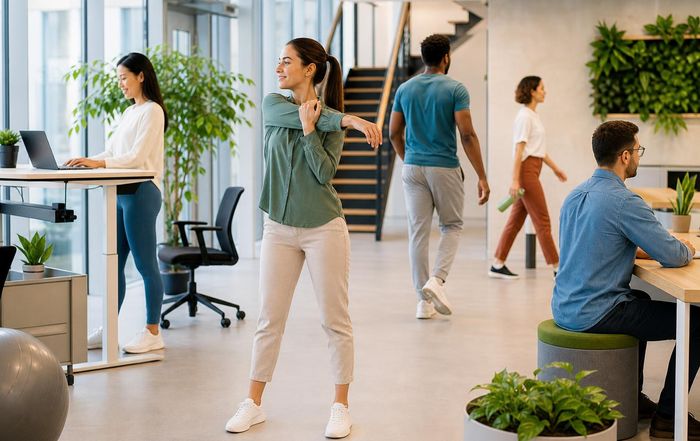
Progressive organizations are integrating height-adjustable desks, shared sit-stand benches, walking paths within office floors, and informal collaboration zones that encourage employees to change posture and position throughout the day. The International WELL Building Institute has codified many of these principles in its WELL Building Standard, which emphasizes movement-supportive design, access to stairs, and ergonomic workstations. Explore movement-supportive workplace design at the International WELL Building Institute.
However, space alone is not enough. Without cultural permission, employees may hesitate to stand, stretch, or walk during calls, particularly in hierarchical or high-pressure environments. Senior leaders and people managers therefore play a pivotal role in normalizing movement, for example by holding walking one-to-one meetings, scheduling short stretch breaks before or after critical sessions, and explicitly encouraging camera-off walking calls for appropriate meetings. Such behaviors, when modeled consistently by executives in the United States, Europe, and Asia alike, signal that movement is not a sign of disengagement but rather a legitimate, valued part of productive work.
For organizations covered here, this cultural shift often intersects with broader conversations about performance, inclusion, and psychological safety, where employees feel trusted to manage their energy and health in ways that support both personal and organizational goals. Readers can explore related unaffiliated perspectives on culture and performance at the FitPulseNews culture section.
Integrating Micro-Movements into the Workday
One of the most practical and scalable strategies for encouraging daily movement is the intentional design of micro-movements: short, low-friction bouts of activity that can be integrated into even the busiest work schedule. These can include standing or pacing during phone calls, performing brief mobility exercises between tasks, using stairs instead of elevators, and incorporating dynamic stretches at the start of team meetings.
Evidence from organizations such as the American College of Sports Medicine suggests that even brief interruptions to prolonged sitting, as short as two to three minutes every half hour, can have meaningful benefits for metabolic health and musculoskeletal comfort. Learn more about breaking up sedentary time at the American College of Sports Medicine. For companies operating in sectors where employees are tethered to screens for long periods, such as financial services, software engineering, or customer support, micro-movements offer a realistic entry point that does not require major schedule restructuring.
Technology is playing an increasingly important role in this space. Wearables from brands like Apple, Garmin, and Fitbit, along with smartphone-based wellness apps, can prompt users to stand, move, or stretch at regular intervals, often integrating with corporate wellness platforms and HR systems. The Mayo Clinic has highlighted how regular movement breaks can alleviate back pain and improve posture, which are common complaints in desk-based roles across North America, Europe, and Asia. Learn more about workplace ergonomics and movement at the Mayo Clinic.
From the perspective of FitPulseNews, micro-movements sit at the intersection of fitness, health, and wellness, offering accessible, evidence-based actions that readers can implement without waiting for large-scale organizational change. When scaled across thousands of employees in markets such as Germany, Japan, Brazil, and South Africa, the cumulative impact of these small changes can be substantial.
Structured Movement Programs and Active Breaks
While micro-movements create a foundation, many organizations are going further by embedding structured movement programs into the rhythm of the workday. These initiatives can range from scheduled stretch sessions and guided mobility breaks to on-site or virtual fitness classes tailored to different fitness levels and cultural contexts.
Companies in the United States, United Kingdom, and the Nordic countries have been early adopters of short, guided exercise breaks, often led by internal wellness champions or external providers. These sessions, typically lasting 10 to 20 minutes, may focus on neck and shoulder mobility, lower back health, or simple cardio activities that can be performed in office attire. The National Health Service in the UK offers accessible guidance on simple workplace exercises, which many employers adapt for internal programs. Learn more about simple office exercises at the NHS Live Well pages.
In parallel, many global organizations are expanding access to fitness classes through digital platforms that employees can join from offices, homes, or co-working spaces in cities such as Toronto, Berlin, Singapore, and São Paulo. These classes often include yoga, Pilates, functional strength, and low-impact cardio, with recordings available on demand for employees in different time zones. The American Heart Association has emphasized that such activities contribute to cardiovascular health and stress reduction, both of which are central to sustainable high performance. Learn more about heart-healthy activity at the American Heart Association.
From the vantage point of FitPulseNews, structured movement programs also provide an opportunity for brands and wellness providers to collaborate with employers, creating integrated experiences that reinforce both corporate and consumer-facing health narratives. Readers interested in how brands are shaping this space can explore the FitPulseNews brands section for case studies and emerging partnerships.
Active Commuting and Mobility-Friendly Policies
Encouraging movement does not need to be confined to working hours. Many organizations in cities across Europe, North America, and Asia-Pacific are actively promoting active commuting and mobility-friendly policies as a way to embed physical activity into daily routines while also supporting environmental and sustainability objectives.
Policies that support walking, cycling, and public transit use can include secure bike storage, shower and changing facilities, flexible dress codes, and financial incentives or subsidies for bicycles and transit passes. In cities such as Amsterdam, Copenhagen, and Berlin, where cycling infrastructure is well developed, employers are aligning with municipal initiatives to further reduce car dependency. The European Commission has highlighted active mobility as a key component of sustainable urban transport and public health. Learn more about active mobility policies at the European Commission mobility pages.
In parallel, employers in the United States, Canada, and Australia are exploring how flexible start times and hybrid work arrangements can reduce commuting stress while still encouraging movement. For example, employees may be encouraged to walk or run before starting work from home, or to break up long days of remote meetings with outdoor walks. The National Institutes of Health in the United States has documented the mental health benefits of outdoor physical activity, including reduced anxiety and improved mood, which are particularly relevant in high-pressure professional environments. Learn more about nature and mental health at the NIH.
These policies intersect directly with environmental and sustainability agendas, areas that FitPulseNews explores in its environment and sustainability coverage. Movement-friendly commuting is increasingly seen not only as a wellness tactic but as a visible expression of corporate responsibility and urban citizenship.
Digital Wellness Platforms, Wearables, and Data Ethics
By 2026, digital wellness platforms and wearable technologies are deeply embedded in workplace wellness strategies, particularly in technology-forward markets such as the United States, United Kingdom, Singapore, South Korea, and Japan. These platforms integrate step counts, active minutes, heart rate data, and even sleep metrics, providing employees with personalized feedback and employers with anonymized, aggregated insights into activity trends across regions and business units.
Major technology providers and health organizations have highlighted the potential of data-driven wellness to improve engagement and outcomes, provided that privacy and ethics are handled with rigor. The National Institute for Health and Care Excellence (NICE) in the UK has issued guidance on digital health interventions, emphasizing the importance of evidence-based design and clear data governance. Learn more about digital health standards at NICE.
From a movement perspective, digital platforms enable step challenges, activity streaks, and gamified leaderboards that can connect employees across offices in New York, London, Frankfurt, Singapore, and Sydney. However, leading organizations are careful to frame participation as voluntary and supportive rather than competitive or punitive, recognizing that employees vary widely in fitness levels, health conditions, and comfort with data sharing. The Office of the Privacy Commissioner of Canada and similar regulators in Europe and Asia have underscored the need for transparency, consent, and proportionality in workplace data collection. Learn more about privacy considerations in workplace programs at the Office of the Privacy Commissioner of Canada.
For the FitPulseNews readership, which is deeply engaged with technology and innovation, the critical question is not whether to use digital tools, but how to leverage them responsibly to support movement without eroding trust. Clear communication, robust anonymization, and employee involvement in program design are emerging as best practices in this area.
Inclusive Movement: Adapting for Diverse Roles and Abilities
Effective workplace movement strategies must account for the full diversity of roles, abilities, and cultural contexts across global organizations. Employees in logistics, manufacturing, healthcare, and retail may already be highly active physically, while knowledge workers in finance, law, or software may be predominantly sedentary. Additionally, employees with disabilities, chronic conditions, or temporary injuries require tailored approaches that enable participation without risk.
The World Health Organization and disability advocacy organizations have emphasized the importance of inclusive design in health promotion, ensuring that programs do not inadvertently exclude or stigmatize individuals who cannot participate in conventional activities. Learn more about disability-inclusive health at the World Health Organization disability pages. For example, chair-based exercises, gentle mobility routines, and adaptive yoga can provide accessible movement options for a wide spectrum of employees, including older workers and those with mobility limitations.
Cultural nuances also matter. In some regions, group exercise during work hours may be enthusiastically embraced, while in others, employees may prefer more discreet or individualized options. Multinational employers operating in countries such as China, India, Brazil, and South Africa are learning to localize movement initiatives while maintaining global consistency in objectives and messaging. The International Labour Organization has highlighted the importance of occupational health and safety frameworks that respect local norms while upholding universal principles. Learn more about global workplace health standards at the International Labour Organization.
For FitPulseNews, which reaches readers across continents and cultures, inclusive movement is central to credible coverage of workplace wellness. Articles and analyses in the world and news sections increasingly spotlight organizations that design programs with, rather than merely for, their employees, incorporating feedback from diverse demographic and functional groups.
Leadership, Measurement, and Long-Term Integration
Sustaining movement-focused workplace wellness requires more than isolated initiatives; it demands leadership commitment, thoughtful measurement, and integration with core business processes. Senior executives in leading firms across the United States, Europe, and Asia-Pacific are now explicitly linking wellness, including daily movement, to strategic priorities such as innovation, risk management, and employer branding.
Measurement practices are evolving beyond simple participation rates in wellness programs to encompass broader indicators such as absenteeism, healthcare claims, employee engagement scores, and even innovation metrics. The Institute for Health Metrics and Evaluation has provided global data on health risks and outcomes that can help organizations benchmark their populations against national and regional baselines. Learn more about global health metrics at the IHME. At the organizational level, anonymized pulse surveys and focus groups can reveal whether employees feel genuinely supported in moving more, or whether cultural and workload barriers persist.
Integration is equally important. Movement initiatives that are aligned with performance management, leadership development, and talent strategies are more likely to endure than those positioned as standalone HR projects. For example, leadership programs that incorporate physical resilience, energy management, and movement-based learning can reinforce the message that taking care of one's body is integral to effective leadership. Similarly, onboarding processes that introduce new hires to movement-friendly norms and resources can embed expectations from day one.
Within the FitPulseNews ecosystem, these themes are reflected across sections from business and jobs to sports and wellness, highlighting how organizations that treat movement as a strategic asset rather than a peripheral benefit are better positioned to compete for talent and market share.
The Future of Movement-Centered Work in a Hybrid World
Looking ahead, the future of workplace movement will unfold across a spectrum of environments: corporate campuses in major cities, distributed home offices, co-working hubs, and increasingly, virtual and augmented reality spaces. As companies refine their hybrid work models, the challenge will be to maintain consistent support for movement regardless of where work is performed.
Emerging technologies such as virtual reality fitness experiences, AI-driven posture coaching, and personalized activity recommendations based on biometric and contextual data are beginning to enter the mainstream. The Massachusetts Institute of Technology and other research institutions are exploring how human-computer interaction can promote healthier behaviors in digital workspaces. Learn more about human-centered technology research at the MIT Media Lab. However, technology will remain only one part of the equation; human leadership, cultural norms, and thoughtful policy design will continue to determine whether these tools are used in ways that genuinely enhance wellbeing.
For the sporty happy and growing community of FitPulseNews, which covers interests in fitness, health, sports, brands, innovation, the message is clear: movement is no longer a peripheral concern but a central pillar of sustainable performance and organizational resilience. As companies in the United States, Europe, Asia, Africa, and South America navigate demographic shifts, evolving employee expectations, and intensified competition, those that embed daily movement into the fabric of work will be better equipped to attract top talent, foster creativity, and deliver long-term value to stakeholders.
In 2026, workplace wellness ideas that encourage daily movement are not merely about more active employees; they are about building healthier, more adaptive, and more human-centered organizations. For leaders, practitioners, and employees alike, the opportunity is to move beyond slogans and step challenges toward a holistic, evidence-based approach that integrates movement into how work is designed, led, and experienced every day. Readers can continue to follow these developments and explore practical strategies across the full FitPulseNews 100% fresh and new platform at fitpulsenews.com.